Meal Recommendation
Key Idea
Our meal recommendation work develops fair, personalized, and health-aware recommendation methods that help users make better meal choices over time, with structured recipe understanding supporting richer reasoning and retrieval.
Quick Start
- Explore BEACON, our personalized meal planning system for optimized meal choices over time. [Demo] [Paper] [GitHub]
- Return to the broader Trustworthy Group Recommendation page for team formation and fairness-focused group recommendation work.
Meal Recommendation
Key Contacts: Nitin Gupta, Vansh Nagpal, Kausik Lakkaraju, Siva Likitha Valluru, Biplav Srivastava
External Collaborators: Sriraam Natrajan, Ram Manohar Singh
BEACON System - Now Available!
We have developed BEACON (Balancing Convenience and Nutrition), a personalized meal planning system that helps people make optimized meal choices over time periods. The system incorporates food restrictions, chronic health conditions, regional cuisine preferences, and balances short- and long-term constraints to promote individual health and happiness.
Personal health can benefit significantly from meals planned over extended periods, whether for a single day, a three-day travel period, or an entire week. Our research addresses this through BEACON, a data-driven meal recommender system designed to help both healthy individuals and people with health conditions (such as diabetes) make optimized meal choices.
The system leverages several innovative components:
- Variable Meal Configurations: Users can customize meal structures (breakfast, lunch, dinner) with different components (main course, side dishes, beverages, desserts)
- Flexible Time Horizons: Recommendations span from single days up to multi-day periods, enabling better long-term planning
- Rich Recipe Representation (R3): Recipes are converted from text to a structured, multimodal format that captures both content and preparation processes
- Advanced Recommendation Algorithms: Using contextual bandits and reinforcement learning, the system learns user preferences and provides highly personalized recommendations
- Comprehensive Goodness Metrics: Evaluations consider duplicate avoidance, meal coverage, and alignment with user dietary constraints
- Fairness Evaluation: Ensures recommendations are unbiased and not stereotyped toward any group of food items or user demographics
The system has been deployed and tested with real users, demonstrating significant improvements over baseline methods in balancing convenience with nutritional needs. BEACON represents a novel approach to meal recommendation that moves beyond simple food suggestions to comprehensive meal planning with health optimization.
Representative Publications
-
[2025] A Novel Approach to Balance Convenience and Nutrition in Meals With Long-Term Group
Recommendations and Reasoning on Multimodal Recipes and its Implementation in BEACON
Presented at WAIN workshop at IEEE ICDM 2025
[Paper] [Demo] [GitHub]
-
[2025] An empirical study on the use of Large Language Models (LLMs) to translate recipes into a semi-structured data format
Conference Poster at the National Big Data and Health Science Conference
[Poster]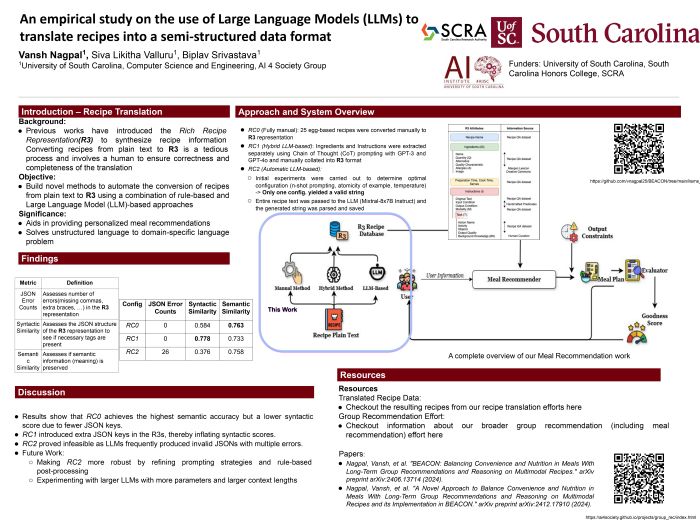
-
[2024] A Novel Approach to Balance Convenience and Nutrition in Meals With Long-Term Group
Recommendations and Reasoning on Multimodal Recipes and its Implementation in BEACON
Presented at National Big Data and Health Science Conference 2025
as A Digital Twin for Increasing Adherence to Dietary Guidelines with Personalized, AI-Driven, Long Duration Meal Recommendations. [Paper] [BibTex]
-
[2024] BEACON: Balancing Convenience and Nutrition in Meals With Long-Term Group Recommendations and
Reasoning on Multimodal Recipes
Arxiv Preprint
[Paper] [BibTex]
-
[2022] Learning About People's Attitude Towards Food Available in India and Its Implications for Fair AI-based Systems
IEEE International Conference on Data Mining Workshops (ICDMW)
[Paper]
Recipe Recommendation
Collaborators over the years: Vishal Pallagani, Vedant Khandelwal, Kausik Lakkaraju, Revathy Venkataramanan, Biplav Srivastava
External Collaborators: Priyadharsini Ramamurthy, Sathyanarayanan N. Aakur
Cooking domain is a popular use-case to demonstrate decision-support (AI) capabilities in service of
benefits like precision health with tools ranging from information retrieval interfaces to task-oriented
chatbots. The recipes today are handled as textual documents which makes it difficult for machines to
read, reason and handle ambiguity. This demands a need for better representation of the recipes,
overcoming the ambiguity and sparseness that exists in the current textual documents. We constructed a
machine-understandable rich recipe representation (R3), in the form
of plans, from the recipes available in natural language. R3 is infused with additional knowledge such
as information about allergens and images of ingredients, possible failures and tips for each atomic
cooking step.
To show the benefits of R3, we also built TREAT, a tool for recipe
retrieval which uses R3 to perform multi-modal reasoning on the recipe's content (plan objects -
ingredients and cooking tools), food preparation process (plan actions and time), and media type
(image, text). R3 leads to improved retrieval efficiency and new capabilities that were hither-to not
possible in textual representation.
Representative Publications
-
[2022] A Rich Recipe Representation as Plan to Support Expressive Multi-Modal Queries on Recipe
Content and Preparation Process
Workshop on Knowledge Engineering for Planning and Scheduling (KEPS), International Conference on Automated Planning and Scheduling (ICAPS)
[Paper] [BibTex]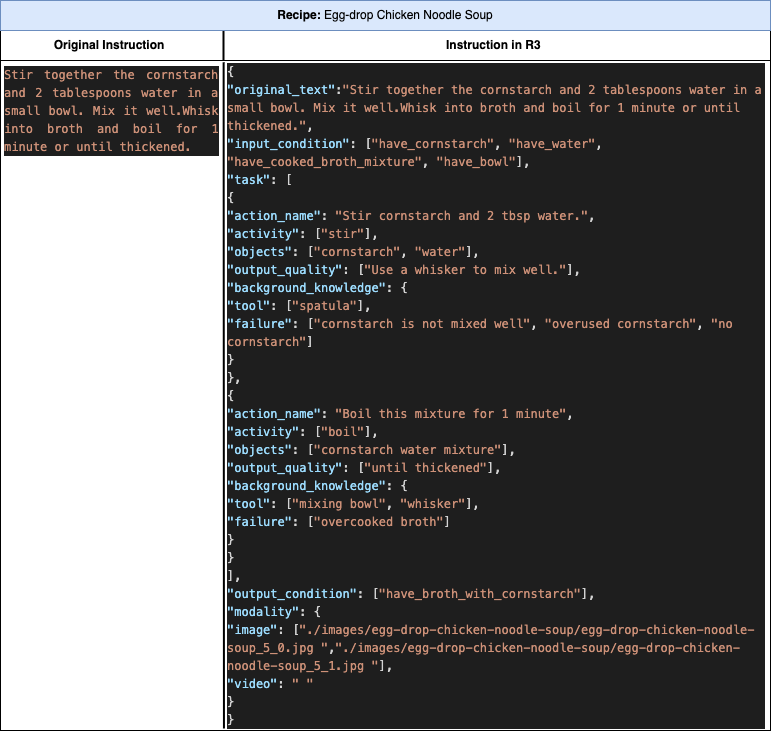
Figure 4: Difference between textual representation and R3 for a single instruction. -
[2022] A Multi-Modal Decision Support System with Allergy-Aware Recipe Understanding Powered by a
Plan Representation
[Paper] [BibTex]

Figure 5: Result of user query of asking recipes containing bacon.