Historically, AI has done well only when not near humans. AI for Society (AI4S) group at the AI Institute is focused on enabling people to make rational decisions despite real-world complexities of poor data, changing goals, and limited resources by augmenting their cognitive limitations with technology. Lead by Prof. Biplav Srivastava, the group works in neuro-symbolic methods, trusted AI, and applications of data-driven methods to society. We innovate as well as apply AI techniques for hard problems facing the society with an inclusive, value-driven, focus.
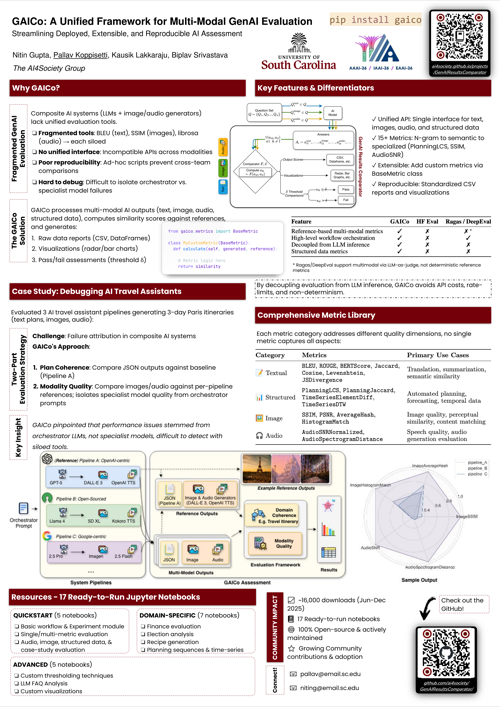
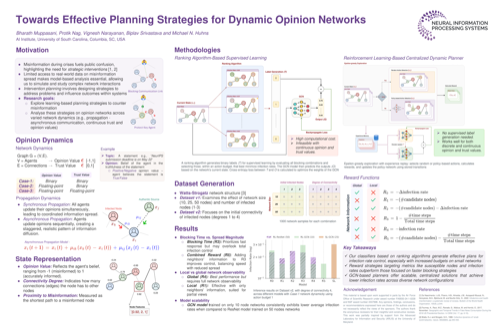
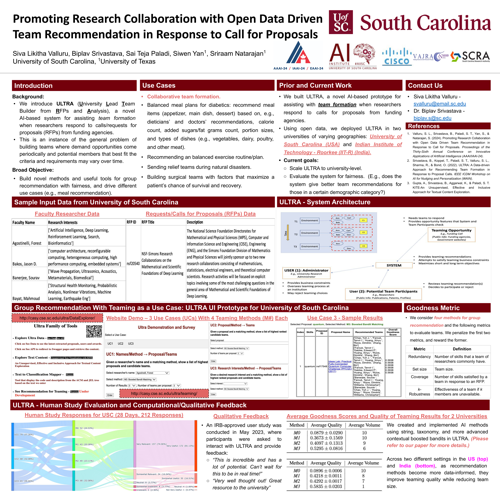
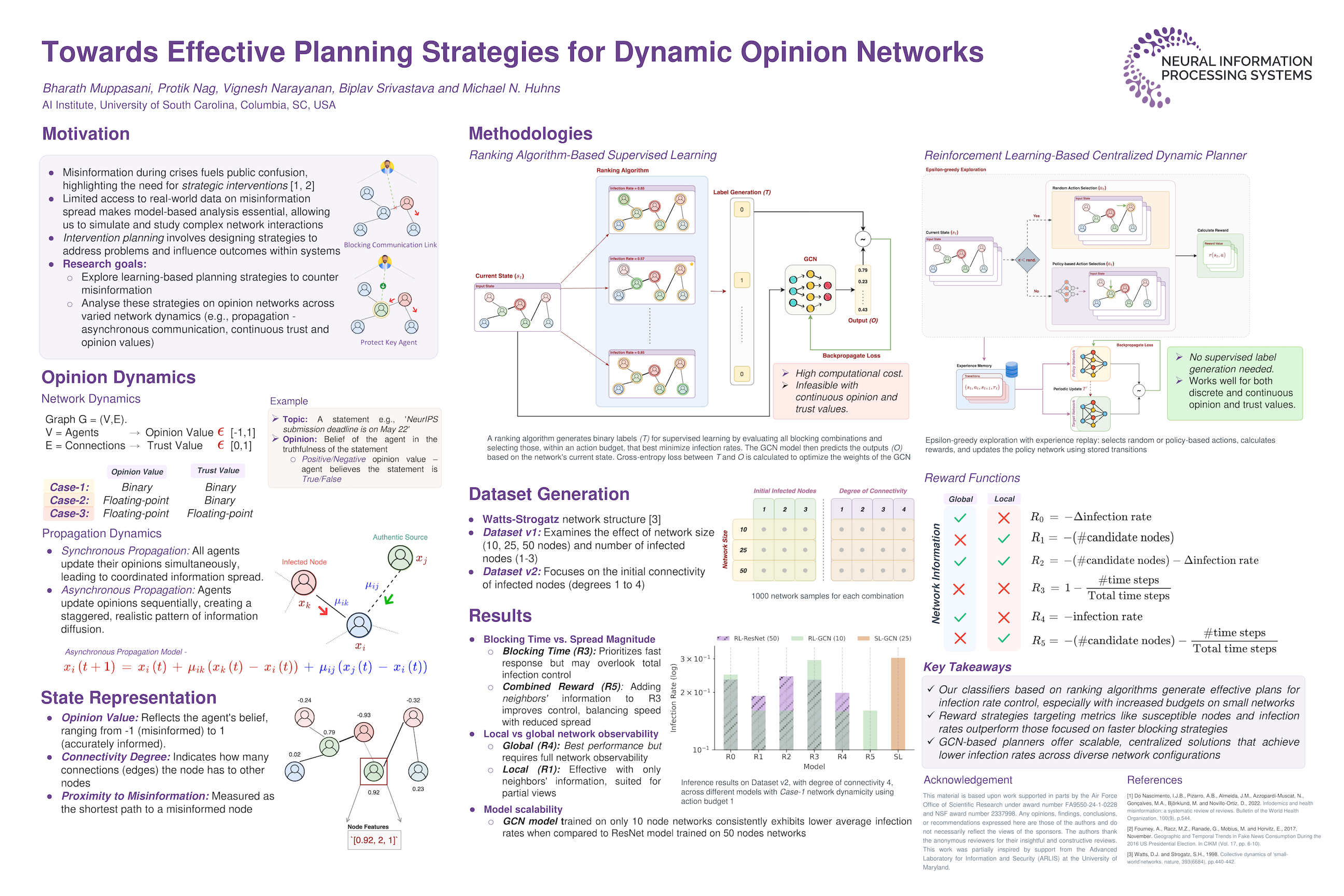
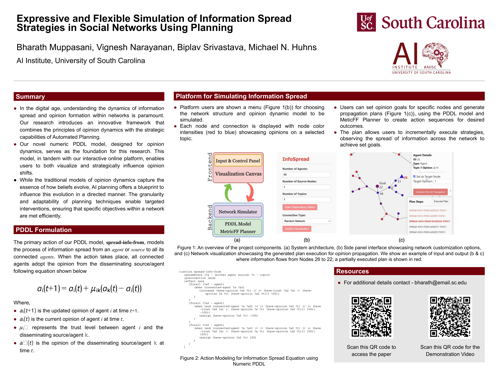
Our differentiating initiatives include working with language models for automated planning, including building compact foundation models for planning-like tasks and creating ontologies for automated planning (generalized planning), black-box assessment and rating for AI (GAICO and ARC tools), group recommendation, metacognition-based SOFAI tool to combine fast (e.g., LLMs) and slow thinking (e.g., reasoners), and exploring AI like chatbots in trust-sensitive domains, viz. elections, nutrition (meals), exercises (Yoga), opinion networks, and traffic (for SC).
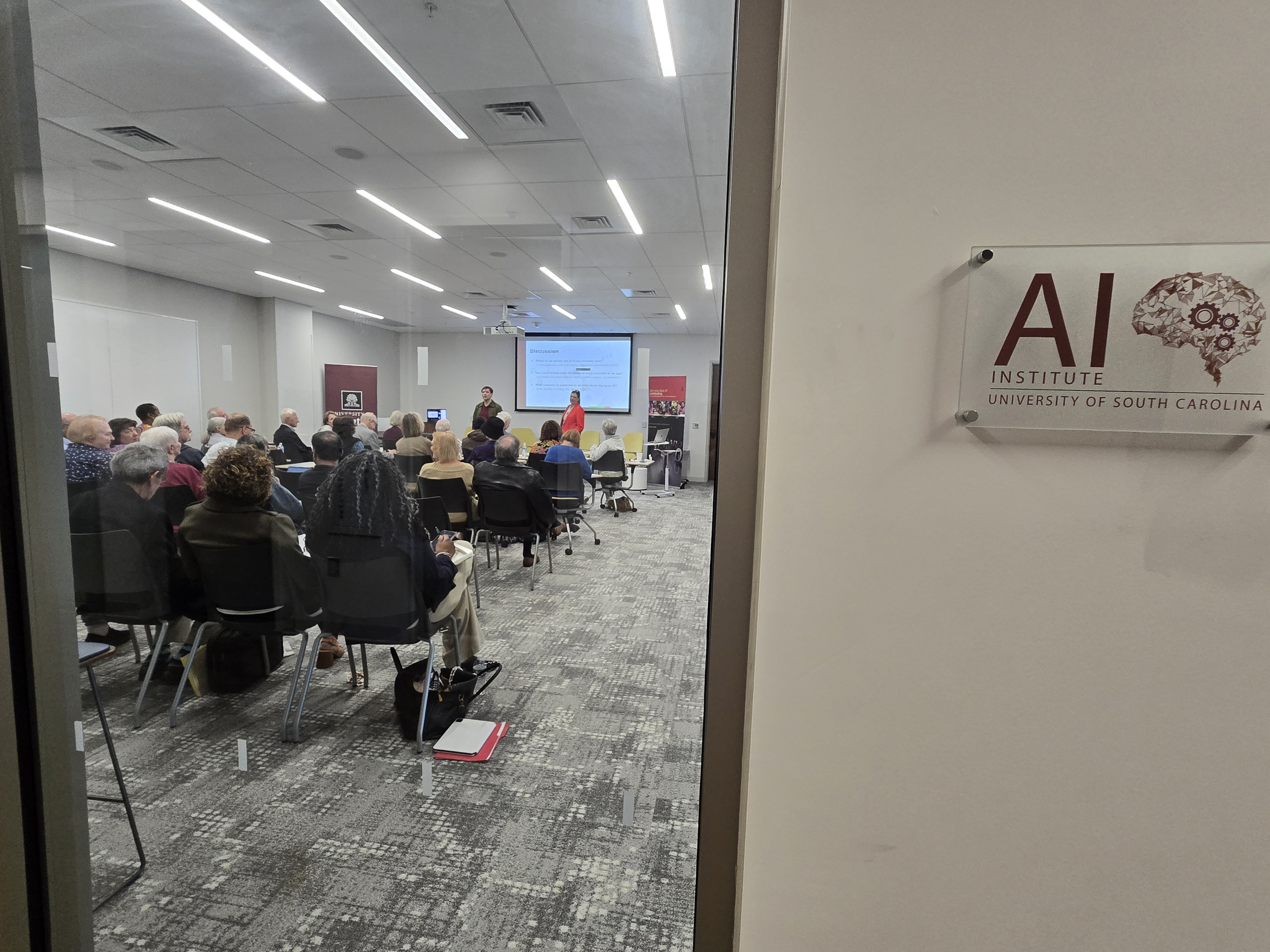
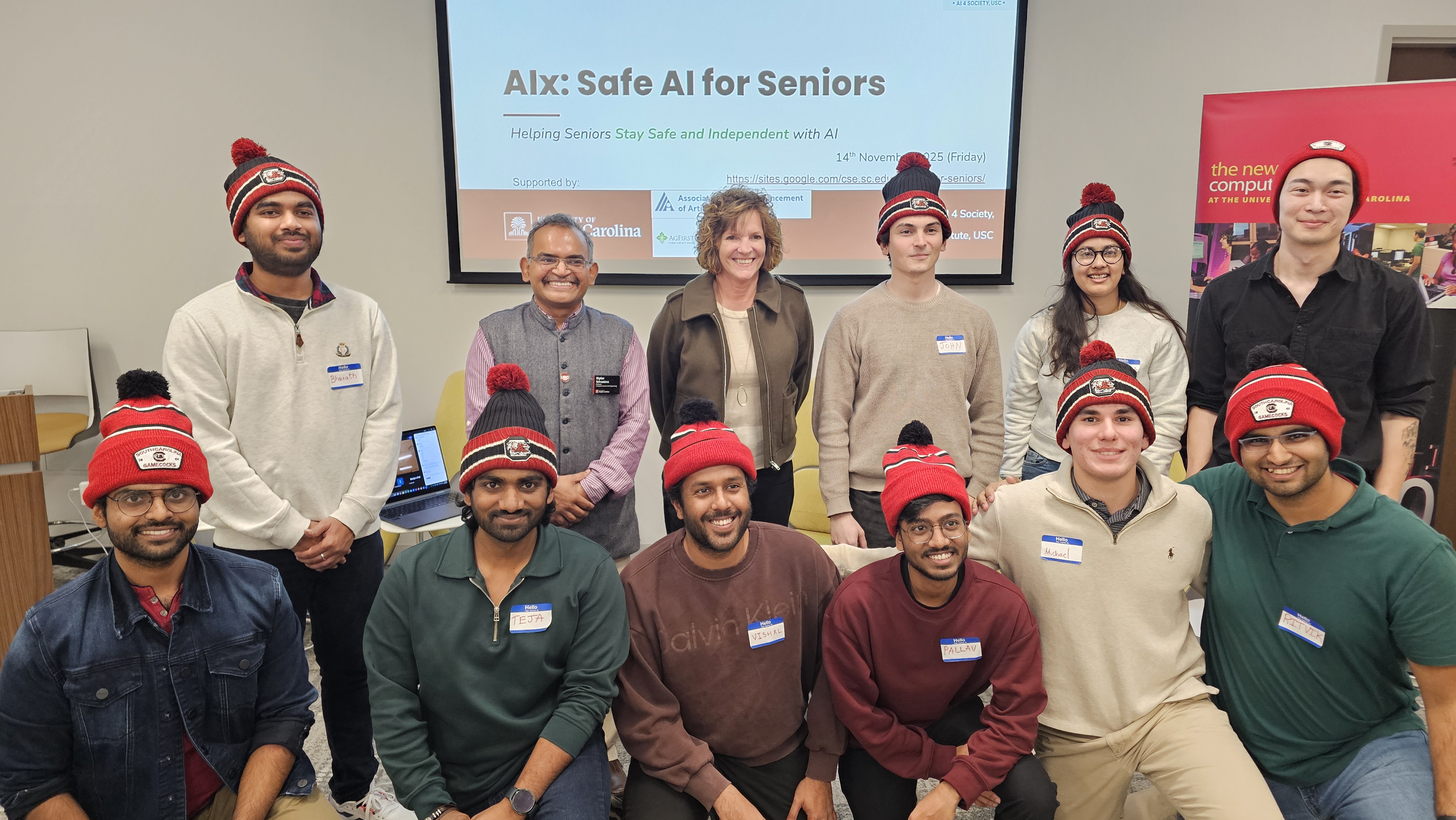
We organized the second day-long, free, community outreach event focused on the role of AI in keeping senior citizens safe and independent called Safe AI for Seniors (SAiS 2026) (summary, program), on Oct 23, 2026.
- Covered by South Carolina Public Radio, highlighting the workshop's panels on cybersecurity and scams, AI and mental health, and data privacy for adults 55 and older (media coverage).
A paper titled ELIOT: Interactively Exploring Fast-Changing Scientific Literature Trends with Online Data and Learning, is accepted at IEEE Big Data 2026, Dec 2026 (AR 38.6%).
A paper titled SN-YO: An Ontology for Modeling Surya Namaskar as a Sequence-Based Yoga Practice, is accepted at ACM CODS 2026, Dec 2026.
Biplav gave a talk, How AI Provides Opportunities to Improve Our Communities - Some Case Studies, at Richland County Planning Conference at Columbia, SC on Sep 26, 2026.
A paper accepted titled Tokenizer Choice Shapes Generalization in State-Centric Learning for Planning, is accepted at Neurips 2026, Dec 2026 (AR 25.7%).
Three papers on AI trustworthiness assessment, agentic reasoning, and AI planning for sustainable transportation accepted at AAAI Fall Symposium, Washington DC, in Nov 2026.
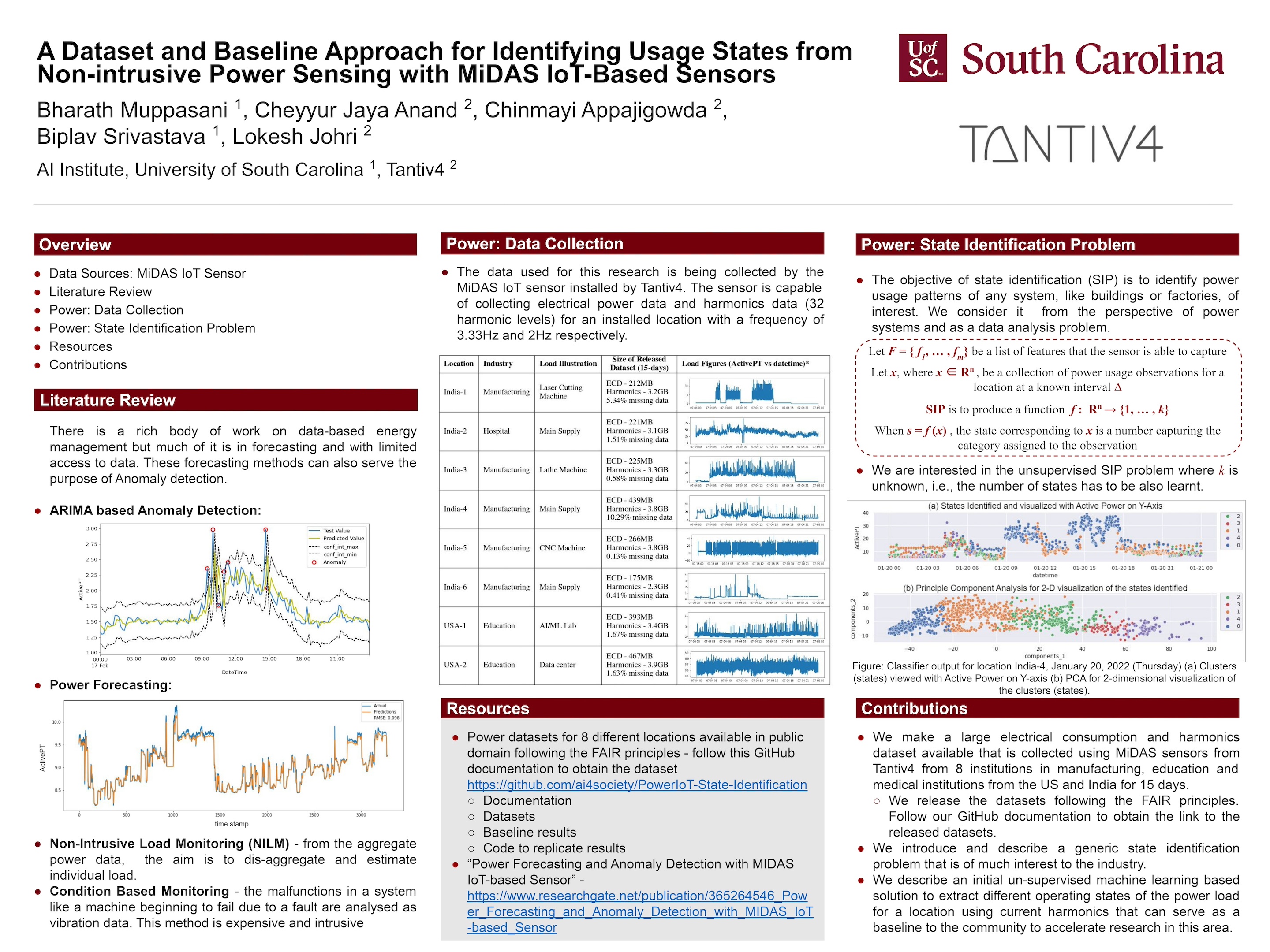
A dataset on sensor data analysis for Yoga, based on our collaboration with IIT-BHU, India, appears on IEEE Dataport, titled Yoga4All: An End-to-End Framework for Collecting Wearable Sensor Datasets to Recognize and Monitor Surya Namaskar Postures on Sep 16, 2026.
Our views on AI safety appeared on WLTX TV, titled Is AI technology moving too quickly? on Sep 16, 2026.
Our views on AI safety appeared on WIS TV and online, titled Is AI a threat to humanity? USC expert, Columbia users separate doom headlines from daily reality on Sep 15, 2026.
Our views on AI safety appeared on ABC Columbia TV and online, titled “I’m not worried” – USC expert weighs in on AI debate on Sep 14, 2026.
Received NSF ICorps award, 2026-2027, to explore technology transfer potential of a Generative AI evaluation tool (GAICo) for businesses (details) [GenAI, Domain Evaluation].
A book titled 'Assessing, Explaining, and Rating AI Systems for Trust - With Applications in Finance', is being released in Aug by Springer Nature (Amazon).
Biplav completes the second VAIBHAV Fellowship (2025-2028; 17 among 216 selected globally) visit for summer work with IIT-BHU on using AI (group recommendation) and sensors for personalized recommendation and monitoring of Yoga's Surya Namaskara (SN; sun salutation) regimen. See project page for details.