Literature Exploration Tool
Team: Nitin Gupta, Bernardo Denkvitts, Vishal Pallagani, Bharath Muppasani, Biplav Srivastava
Key Idea
This project studies how scientific fields evolve and builds tools that help researchers move from keyword search to structured exploration. Given a query, the system retrieves recent papers, groups them into coherent themes, assigns representative keywords, and visualizes how those themes change over time.
Quick Start
-
Try the current Streamlit prototype for query-based paper retrieval, clustering, and temporal exploration.
-
Share feedback through the active survey as we evaluate usefulness, interpretability, and interaction flow.
-
Explore the prior LLM Planning Visualization Tool that motivated this broader literature evolution workflow.
The Literature Exploration Tool
ELIOT generalizes lessons from our ICAPS 2024 and ICAPS 2025 LLMs-in-planning surveys into a domain-flexible literature exploration system. The current paper is available as an arXiv preprint and has been submitted to the CIKM Applications Track. A public prototype and feedback survey are available now (see above).
The tool has the following features that support literature evolution understanding and exploration:
- Dynamic retrieval: users can search arXiv using single-word and multi-word keywords, with filters such as subject category, date range, sorting criteria, and result limits.
- Theme discovery: titles and abstracts are embedded, reduced in dimension, and clustered so users can inspect semantically related groups instead of a flat result list.
- Cluster labels: cluster-level keywords summarize each theme using distinctive terms, making the retrieved papers easier to scan and compare.
- Temporal views: trend visualizations help users understand how themes emerge, grow, decline, or split as a research area changes over time.
Broader Line of Work
This tool is connected by a sequence of literature understanding projects: first, a curated taxonomy of LLMs in automated planning and scheduling; second, semi-automated updates that detect category drift; and now, ELIOT, a more general tool for exploring literature evolution in any queried domain.
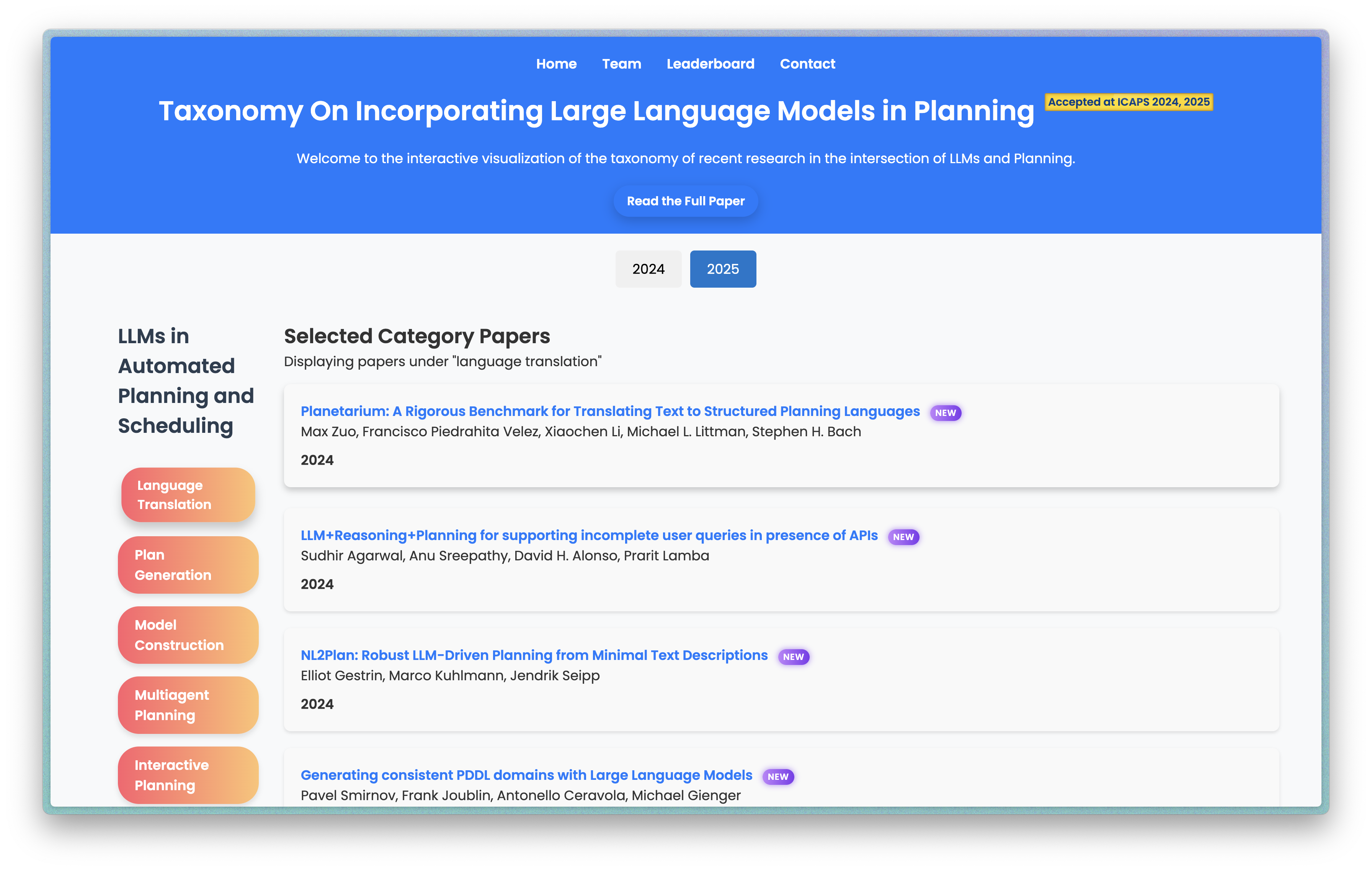
ICAPS 2024: Manual taxonomy. A survey of 126 papers on LLMs in Automated Planning and Scheduling organized the field into eight categories, including plan generation, language translation, model construction, tool integration, and interactive planning. [2024 Paper]
ICAPS 2025: Evolving categories. A semi-automated analysis added 47 papers, reported drift across existing categories, and surfaced emerging categories such as goal decomposition and replanning. [2025 Paper]
Interactive visualization. The earlier visualization tool remains a concrete example of the project goal: making research categories browsable, updateable, and useful for researchers who need to understand a fast-moving field.
Representative Publications
-
On the Prospects of Incorporating Large Language Models (LLMs) in Automated Planning and Scheduling (APS)
Vishal Pallagani, Bharath Chandra Muppasani, Kaushik Roy, Francesco Fabiano, Andrea Loreggia, Keerthiram Murugesan, Biplav Srivastava, Francesca Rossi, Lior Horesh, Amit Sheth. ICAPS 2024.
[Paper] [Tool] -
Revisiting LLMs in Planning from Literature Review: a Semi-Automated Analysis Approach and Evolving Categories Representing Shifting Perspectives
Vishal Pallagani, Nitin Gupta, Bharath Chandra Muppasani, Biplav Srivastava. ICAPS 2025.
[Paper] [Tool] -
ELIOT: Interactively Exploring Fast-Changing Scientific Literature Trends with Online Data and Learning
Bernardo A. Denkvitts, Nitin Gupta, Biplav Srivastava. arXiv preprint, submitted to the CIKM Applications Track, 2026.
[Paper] [Tool]
Category Drift
The ICAPS 2025 update showed how a taxonomy changes as the field matures: some categories shrink in relative share, others grow, and new categories appear as researchers ask more specific questions.
Still dominant in D2, but its relative share decreases.
Declines as translation is treated as necessary but insufficient for planning.
Decreases as end-to-end interactive use remains difficult to scale reliably.
Grows and becomes the second-highest category in D2.
Maintains a stable presence across the two datasets.
Increases and reaches the third-highest share in D2.
Declines as work shifts toward concrete neuro-symbolic architectures.
Decreases as coordination reliability remains a major challenge.
Emerges in D2 with 4 papers focused on subgoal structuring.
Emerges in D2 with 1 paper centered on plan adaptation after failure.
Acknowledgments
We thank Aarohi and Thrinadh for their contributions as interns on this project.